- New Growth Hacks Revealed Every Week!
- Posts
- 🍾 Don't MO on FOMO Marketing
🍾 Don't MO on FOMO Marketing
GM, growth hackers 📈🔐
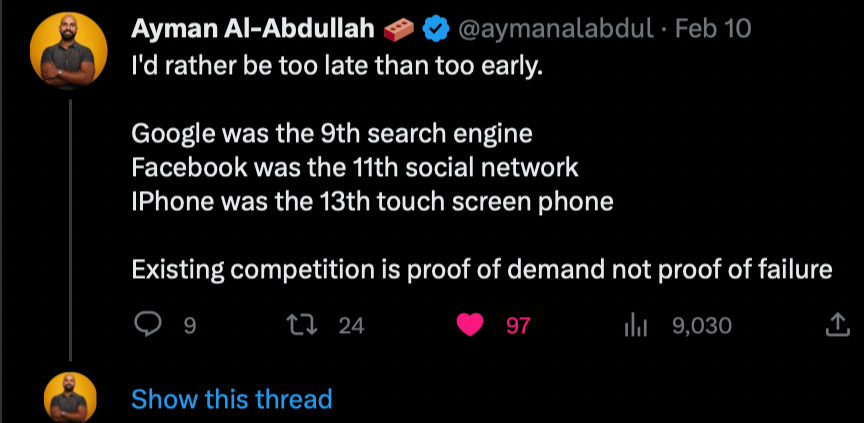
Early bird may get the worm, but there are better Ws to earn than worms. Don’t let not getting in early keep you from getting in better. Nice take by Ayman.
→ FOMO Marketing 🍾
→ Juicing Your Email List 👆
→ Growth Hacker Hall of Fame: Groupon’s Growth ✅
→ More premium content… 👀
No time to waste, LFG 😤
Growing Your Email List 👆
Everyone’s tryna grow their email list. Is anybody succeeding?
Some of us, but it doesn’t come easy. And going in blind is not it.
Liked this article— “Top 10 Ways to Effectively Grow Your Email List.” A few of them were pretty obvious, but some are worth filling you in on.
Here’s a freebie: start a killer newsletter.
But here are three 3 more from the article:
1. QR Codes
“Adding unique QR Codes to a wide range of marketing materials, such as: digital business cards, print ads, flyers, signs and banners, billboards, and receipts.
These QR Codes encourage people to scan them with their smartphones. From there, users are prompted to enter their email addresses or any other information marketers wish to collect. QR Code marketing is especially effective when brands offer consumers something in return for their email address. This can include a special coupon code or discount.”
2. Lead magnets
If you’re not already using lead magnets, you’re cheating yourself. Some call it an “opt-in offer,” while others cut the crap and call it an “ethical bribe.” Either way, you’re giving someone a positive-value reason to give you their contact info. What’s in for them? Well…
“Free “cheat sheets,” starter kits, online course content, workshops, customized plans, eBooks, and white paper”
are all mentioned as good starting points for this strategy.
3. Referral contests
This common growth hack has been used by almost every major B2C start-up of the last decade. The big dogs are always using it. You can, too.
The long and short of it? Use the trust you’ve already earned to convert more customers. Your average consumer is 90% more likely to trust your friend than you (again, don’t take it so personally). So, incentivize the customer by cutting them a deal, or gamifying it:
“The subscriber who gets the most referrals to sign up for your email list by a certain date wins the contest and receives a prize or reward. This could be anything from recognition on your social media page to a special discount or free product/service.”
Don’t MO on FOMO 🍾
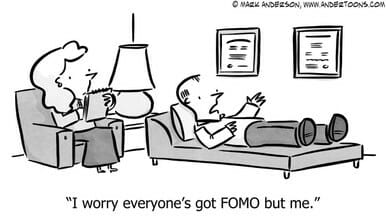
We all know FOMO. If you’re reading this, you know it well. The fear of missing out on the newest hack to massive gains. Or actually missing out on life because we’re too busy chasing the bag… gotta admit, it’s familiar. But turns out some experience re: FOMO isn’t so bad.
ICYMI: FOMO Marketing is a thing. And one you should really know about. What’s its deal?
→ utilizes consumer psychology to urge shoppers to take action
→ leverages common consumer impulse to seize limited opportunities
→ generates fear that inaction will result in missing out on something extraordinary
Urgency, fear, regret. Powerful stuff. How does it play out?
Usually, something like motivating the consumers by pumping up a short sales cycle. It’s something we all know, but FOMO Marketing turns this common knowledge into a sales-boosting science. But it’s easy to cross the line and come off as a bit pushy— or, worse: desperate. And you’ll find a lot of vague strategies out there. Here are 3 practical, instantly actionable strategies:
1. Tight Time Limits
Create your own Black Friday. And stick to it. Don’t extend, don’t bend. Remember, we’re in the urgency and scarcity game here. Don’t be that brand that makes the “sale price” the norm— easy way to lose trust. Give them a way to watch the clock, and make sure you show off every passed-up opportunity. If you can find a way to add some Exclusivity to the mix? Now you’re cooking with gas.
2. Social Proof
Speaking of trust, social proof always helps. Time and time again, social proof at the end of the purchase funnel helps close the deal. They trust other customers more than they trust you. Don't take it personally. Use customer reviews, testimonials, photos, download and purchase counts. Show people that people are buying, one way or another. Use what you got. 3. Micro-Influencers
At under 50K followers, micro-influencers can come pretty cheap. Especially if you’re just looking for a quote. Their personal touch jacks up the FOMO.
There’s powerful stuff going on with FOMO. It’s a motivator. Don’t MO on FOMO.
Here and There 👀

Thought I’d share some quality growth-relevant articles that caught my attention this week:
→ Getting your KWs in line: scoping out low-hanging fruit, but also prioritizing keywords based on buying intent
→ Closing the deal & converting social media leads
→ Artificial Influence: AI & Influencer Marketing
→ Another 20 Ways to Leverage ChatGPT for Your SEO (never gets old)
→ 24 Do’s and Dont’s re: Social Media Marketing
Growth Hack HOF: Groupon✅
Story time, folks. Here’s another Hall-of-Famer. Even if you’ve heard this one before, it never hurts to listen up again.
If you’re in the game, Groupon is a success tale for the ages. Like, seriously, the stuff dreams are made of. For real. To this day, many of their OG hacks are integrated as signature elements of their platform. Worth mentioning that Groupon managed to figure out referrals, social proof, and a bunch of the key ingredients mentioned in today’s newsletter and optimized the **** out of them.
The result? A platform where businesses manage to benefit from giving wild discounts, consumers benefit from those wild discounts, and Groupon absolutely rakes as the middle-man.
Today, Groupon is a household name. You’ll still find some people who die on the hill that it was “the fastest growing company ever.” Ever. Depends on the metric, obviously, but there’s a case to be made that no start-up has speed-ran growth like Groupon.

Can you say G O A L S? #goals
Here’s how they did it…
1. Early Flexibility
Before Groupon was Groupon, the project was called The Point. This was way back in 2007 (we were all so young).
Looking back, the idea was sweet. A little naive, but sweet: the point of The Point was to help people and businesses solve the projects that they needed solutions to. They’d do this by connecting needy projects with investors and experts. Andrew Mason (goat emoji) managed to earn $1M in seed capital, but the concept just didn’t take off for all sorts of reasons.
Now, they could’ve stayed steady with The Point. But they didn’t. The process taught some valuable lessons. Mainly, Mason realized they had honed in on a minimum viable product (MVP) with serious potential: collective buying/group discounts.
2. Starting Small, Doing it Locally
Groupon literally started at a bar in the office building Andrew Mason & co. were already working in. They convinced the owners to let them try out a 2 for 1 Pizza special. Not sure you can get much more local than that, tbh. Not only that, but they started by compiling a mailing list of people they already knew. Friends, clients, former co-workers, the whole deal.
25 people cashed in. It worked well for the bar, worked well for the customers, worked extremely well for Groupon. No losers. Then, they did an IMAX movie. 50 sold. Doubled up, just like that. That was all occurring at the tail end of 2008. By the end of 2009, they’d grown to 28 American cities. So yeah. Word spread fast. 1) They broke out of the office bar. 2) Soon after, they were well on their way out of Chicago. 3) By early 2010, they’d expanded out of the United States.
3. Nobody Loses, Everybody FOMO’s
This is the kind of utility calculus we dream of dreaming up: customers save as long as the minimum sales target is hit, minimum sales target is determined by what the business needs to hit for the campaign to be profitable. If #2 is looking spotty, #1 motivates customers to get more customers involved so they can hit the minimum.
Remember the FOMO marketing lessons? Here, we’ve got urgency, we’ve got exclusivity, we’ve got gamification, we’ve got referral incentivization, and we’ve got consumers roping in their friends to create more consumers.
4. We Live in A Society
These days, we might use Groupon for any old thing. The dentist. Family portraits. Whatever. But in the early days, they focused on adding that FOMO element to things people already loved.
Movies, dinners and drinks, amusement parks and day trips, nail salon and massage packages. Stuff people already loved. Social things. The bigger your group, the more savings you could rack up. And the better the deal, the more enthusiastic that group would be about getting enough people on board to make sure the Groupon went through.
This created an incredible machinery of word-of-mouth word-spreading, where your best marketers were the customers you were already selling to. Talk about Tom Sawyer getting you to paint the fence. Dang.
And even in those early days, once you made your purchase, Groupon was ahead of the game for social media shareability:
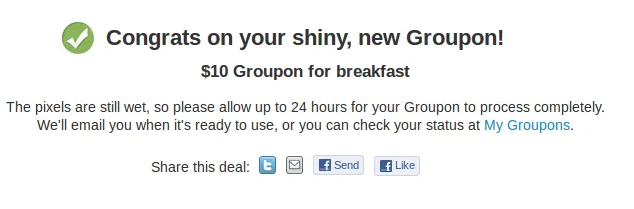
Finally, they quadrupled down on their social strategy by implementing a referral program over and above the referral strategy already propelling the whole operation.
If you could get some folks who had never used Groupon involved, $10 Groupon dollars went their way. Considering the lifetime value of each customer was, on average, $30, Groupon would make about $20 off each new customer. Easy money.
5. Insanely Good Copy
Let’s not forget that Groupon wouldn’t be Groupon without their copywriting. Yes, that’s hyping up the importance of the activity I’m doing right now (biased). But, it’s also an indispensable part of how they rose to greatness. It’s not just that they rose up the ranks, but how they did it. Their strategy led to an always-growing email list, but it didn’t end there. The emails were actually worth reading. The Groupon Writer’s Room earned itself a better reputation than some pretty significant newspapers in the country. Low bar, but still.

Create Value in All Directions: Didn’t take long for Groupon to earn its place as one of the most successful start-ups of all time. Part of what’s unique about their story? They managed to grow exponentially while making everyone happy: consumers, businesses, and themselves. Everyone wins by using Groupon— especially Groupon. Nobody lost (except their competitors). Has there ever been a better middle-man?
Give The People What They Want: Whether it’s the products offered or the messaging they used to spread the word, Groupon has always been all about quality. They keyed on things that were easy to hype up, things everyone already loved. Pizza, movies, salon and spa. Even if you’re in a niche, there’s something to be learned here.
Start Small, Don’t Stay Small: When their initial idea flopped, Groupon didn’t double down on an iffy idea. Instead, Groupon stepped back, simplified, stepped forward in a new direction. Focused on their MVP and let it be their engine. Then, as soon as they had a winning formula? Full speed ahead.
Stat of the Week: Shifting to Search 📊
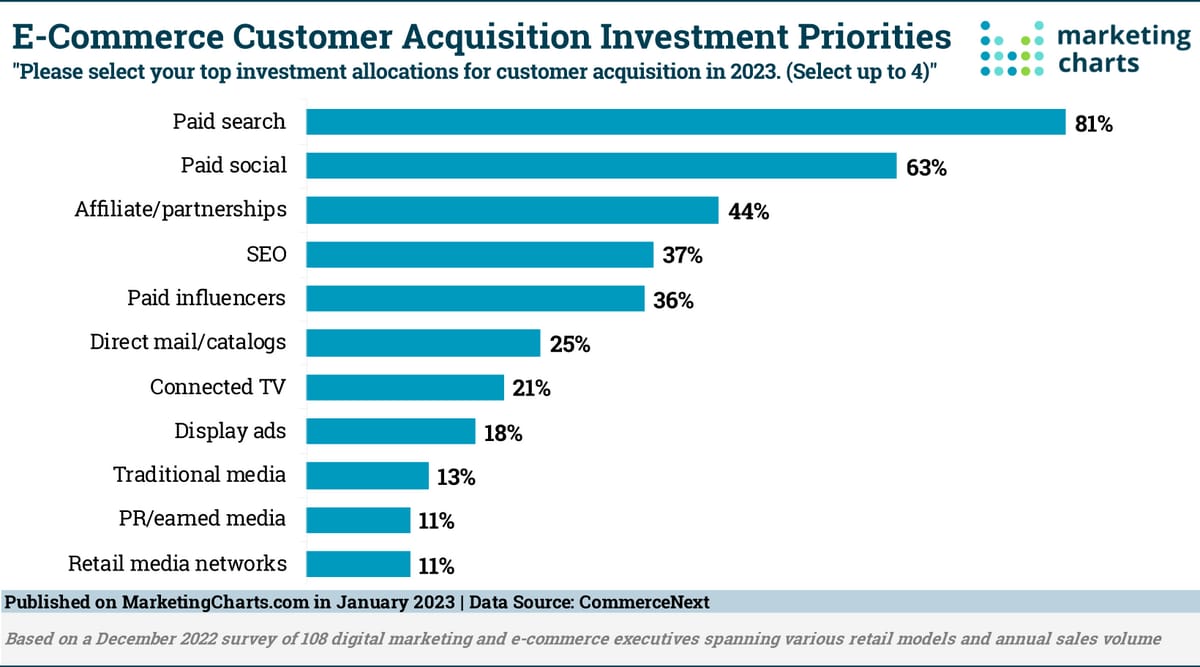
“When asked their top investment allocations for new customer acquisition, 81% cited paid search as being within their top 4, ahead of 63% who cited paid social. This represents a change from last year’s results, when paid social was the top investment allocation for new customer acquisition, ahead of paid search.”
Where would we be without MarketingCharts